

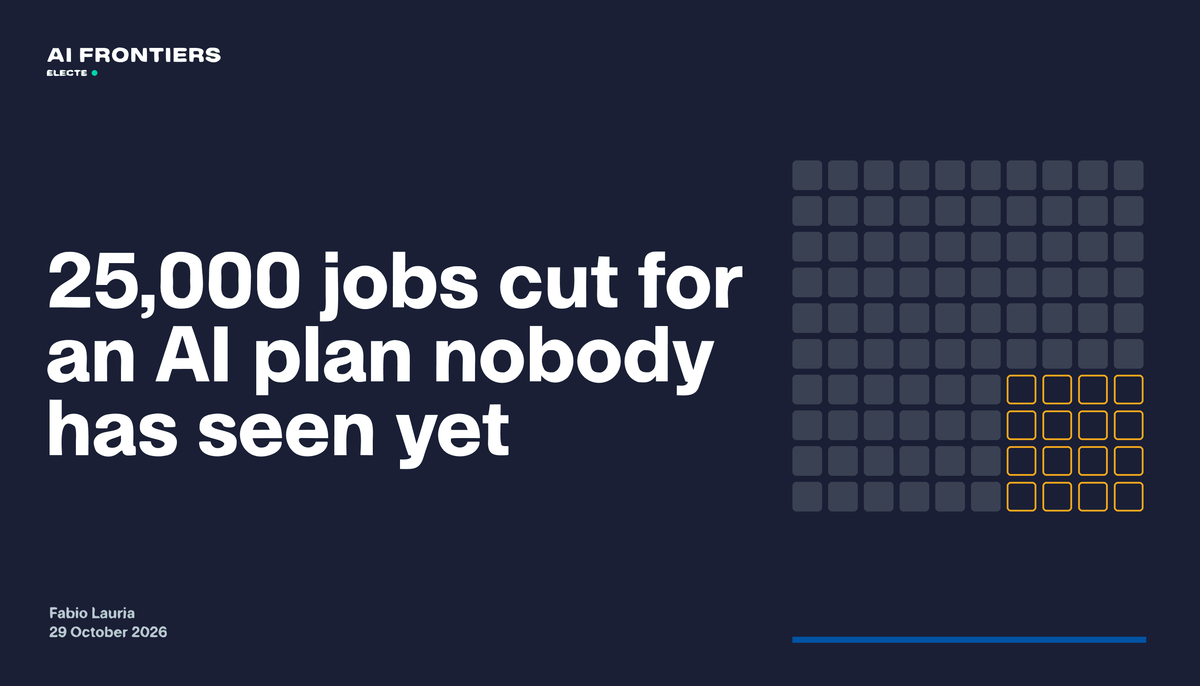
Twenty-five thousand is a precise number. The role artificial intelligence will play in reaching it is not: on 26 October the Dutch government set savings rising to €3.5 billion a year from 2035, an estimated reduction of 25,000 full-time posts, and said the goals and savings plans for AI will follow in the first quarter of 2027.
That gap is worth watching if you run a company, approve technology spending or have ever been handed an efficiency target before anyone explained how to reach it. The question this issue answers is a practical one: how to tell whether AI is making an organisation more productive, or whether the organisation is simply spending less and doing less.
The detail behind the headline
The government’s announcement is mostly organisational: at least 500 rules scrapped or simplified a year, standardised ICT, one desk for every two employees, surplus buildings sold, joint procurement, and the number of advisory bodies cut back. AI receives a single sentence, promising the forthcoming plans.
Those other measures matter, and they are not the same kind of saving. Abolishing an unnecessary procedure removes work altogether. Automating a procedure changes how the work gets done. Selling a building produces a third kind of saving. Put them in one programme and the total bill can fall. The total will not tell you how much AI contributed. That distinction is easily lost once a technology becomes the headline: a savings target starts to sound like a forecast of what the technology will deliver, when the connection has yet to be demonstrated.
Two further facts frame the number. The international headline was “AI-led overhaul”, and the State Secretary cited non-binding parliamentary motions calling for a 20% productivity gain through AI as the reason for the cuts. And the headcount being reduced is the one the state grew: central-government employment reached a record 160,000 at the end of 2025, up 41% on 2018. A 1.8% deficit is no emergency; the stated concern is the long-term outlook. My reading is that the label was chosen for its politics. A reduction described as modernisation costs fewer votes than one described as austerity, and it moves the burden of proof: the government no longer has to show the savings are real; the workforce has to show it cannot be automated.
The savings were decided. AI was hired to explain them.
An uncomfortable precedent
In 2008 the Dutch Court of Audit examined a plan to remove 12,800 posts and save €630 million a year. The auditors challenged an assumed productivity increase of 5% against a trend estimate of 1.3%, and questioned high expectations for ICT alongside limited ICT funding. In March 2025 the previous cabinet set a 22% budgetary target for the central state, rising to €1 billion in recurring annual savings, with 2024 as the baseline year; AI “can play a role”, the ministry wrote, with Parliament to be informed later.
The technology has changed since 2008; the sequence has not. That history does not settle whether today’s programme will succeed, but it does identify the question to ask early: what evidence connects the staffing target to the organisation’s ability to deliver the work? A budget can specify a smaller workforce; making that workforce more productive requires changes to processes, systems and skills, and the two have to be planned together.
Where does the saved time go?
Consider a team using AI to prepare its monthly reports. Drafting becomes faster. The team could use the time to check more figures, investigate anomalies or support more customers; it could also spend some of it correcting the AI’s output. Each outcome has different implications for staffing and cost, which is why a faster task does not automatically produce a smaller payroll. The business needs to understand how the whole workflow changes, including the work that stays with people.
Jabra’s WorkLife 2026 survey illustrates the point. Among more than 6,000 knowledge workers, 85% reported an increase in at least one area of work, which Jabra reads as saved time being reinvested in additional tasks and expectations. The same survey found 30% of top managers to be heavy AI users against 8% of individual contributors, and 64% of those contributors with no AI training or only a brief introduction, against 26% of top management. This is self-reported evidence from six countries, not a measurement of Dutch public-sector productivity. It still points to a practical possibility: an organisation can gain capacity without reducing headcount, and the people deciding that AI will absorb the work are, so far, the ones using it most. For a public service, that capacity might clear a backlog; for a company, it might support growth without hiring. Both are valuable. Neither is a reduction in existing payroll cost. An AI business case needs to say which benefit it is promising.
Time saved is not a post saved until someone shows where the time went.
Three questions before accepting the savings figure
- What improves for the person receiving the service? Look beyond headcount. Measure processing times, completed cases, errors, backlogs and service quality. A smaller team handling comparable demand tells a different story from a smaller team leaving more work unfinished.
- What evidence will show AI’s contribution? Record the starting conditions and track changes in demand, staffing and procedures. Where feasible, compare teams or introduce the technology in stages. Otherwise even a good result will be hard to attribute to AI.
- What does it cost to achieve and maintain the improvement? Include integration, data preparation, training, human review and ongoing operation. Ask when the benefits should appear and whether the savings figure accounts for these costs.
These questions belong in the initial proposal, while there is still time to design an evaluation that means something.
The Dutch plans arrive in 2027. When they do, the number that matters most will not be the €3.5 billion. It will be a processing time, an error rate or the size of a backlog: the figures that show what the saving cost the people who depend on the service. Anyone handed a savings target before the plan should ask for the same.
Sources
- Rijksoverheid — Kabinet werkt aan slagvaardige overheid: eenvoudiger, slimmer en kleiner (26 Oct 2026)
- Rijksoverheid — Kabinet aan de slag met 22% structurele bezuiniging bij rijksoverheid (14 Mar 2025)
- Binnenlands Bestuur — Rekenkamer kraakt afslankplan rijk (23 May 2008)
- Jabra — AI in the Workplace: New Study shows More Tasks, More Collaboration and a Growing Divide (6 Oct 2026)
- Bloomberg via The Star — Dutch government plans to cut 25,000 jobs in AI-led overhaul (27 Oct 2026)
- Gulf News, based on Bloomberg — Netherlands plans to cut 25,000 government jobs using AI to reduce costs (27 Oct 2026)
- Bloomberg via The Edge — Dutch govt plans to cut 25,000 jobs in AI-led overhaul (26 Oct 2026)
Fabio Lauria
CEO & Founder, ELECTE
Every week, we explore AI without the hype — using data, analysis and an independent perspective.

AI Frontiers · every Thursday
Subscribe to AI Frontiers.
Subscribe to keep reading.
The first essay was on us. The rest of this one is for subscribers. Read every essay and receive new editions by email. No payment required.
Comments ()