

Every creative act worth the name is a kind of theft. Shakespeare lifted his plots from Holinshed's chronicles and recycled folktales the groundlings already half-knew. Van Gogh sat with Japanese woodblock prints until their flatness leaked into his brushwork. The Beatles started as a covers band playing other people's American records, night after night, to the drunks and sailors of Hamburg's clubs. None of them apologised, because we don't call this theft. We call it influence, tradition, lineage — the slow composting of everything that came before into something that feels new.
So when a generative model appears to do the same thing — ingests the corpus, finds the patterns, recombines them into something that did not exist a moment earlier — the honest question is the uncomfortable one. Where, exactly, is the difference?
The answer everyone keeps ready
For three years the creative industries have carried a ready reply. The machine doesn't feel. It has no intention, no biography, nothing it is aching to say. It is just statistics — pattern prediction dressed up as art.
I'll grant most of that. A model does not lie awake. It has no childhood, no grief, no debt to a dead mentor it is trying to repay. The line that AI companies love — "it learns just like a person does" — is marketing, and the critics who call these systems mimics, not minds, are right about the mechanism. Prediction is not understanding.
None of it gets you where you want to go. Grant that the machine feels nothing — plenty of human art is made coldly, on deadline, for money, by people with nothing to say, and we protect it anyway. Insist on intention — a camera has none, and we gave photographers copyright a century ago. Every line you try to draw between human and machine creation lets in something you meant to exclude, or shuts out something you meant to keep.
The distinction feels obvious right up to the moment you are asked to write it down.
Then it met a judge
In June 2025 the metaphysics met a courtroom, and the metaphysics lost.
Within two days of each other, two federal district judges in California — in the first substantive rulings squarely about LLM training on copyrighted books — held, on the facts before them, that the challenged training use was fair use. These are trial-court decisions, not the last word; appeals and other suits are still in motion. But the reasoning is what matters here. Judge Alsup called Anthropic's training "quintessentially transformative." In the parallel case against Meta, Judge Chhabria came down the same way on the training claim — but grudgingly, on narrow grounds: the authors hadn't built the record to show the training had harmed the market for their work, and he warned that his ruling did not make Meta's training lawful in general. And here is the part that should stop every artist in the argument cold: Alsup refused to treat a machine reading a book differently from a person reading one. Authors, the reasoning went, cannot stop others from using their work to learn — people have read and re-read books for centuries to make new ones.
Read that again. The analogy the AI companies had been selling — a machine reading is no different from a person reading — is the one the court picked up and turned against the artists.
So what was the fight actually about?
Follow the money, because the same case hands you the answer. Anthropic still agreed to pay around $1.5 billion — about $3,100 a book, across some 482,000 titles. Not for learning. For piracy — for downloading and hoarding a library of stolen copies. The court blessed the training use and condemned the pirated library.
Pirating copies to build a research library without paying for it, and to retain copies should they prove useful for one thing or another, was its own use — and not a transformative one.
— Judge William Alsup, Bartz v. Anthropic
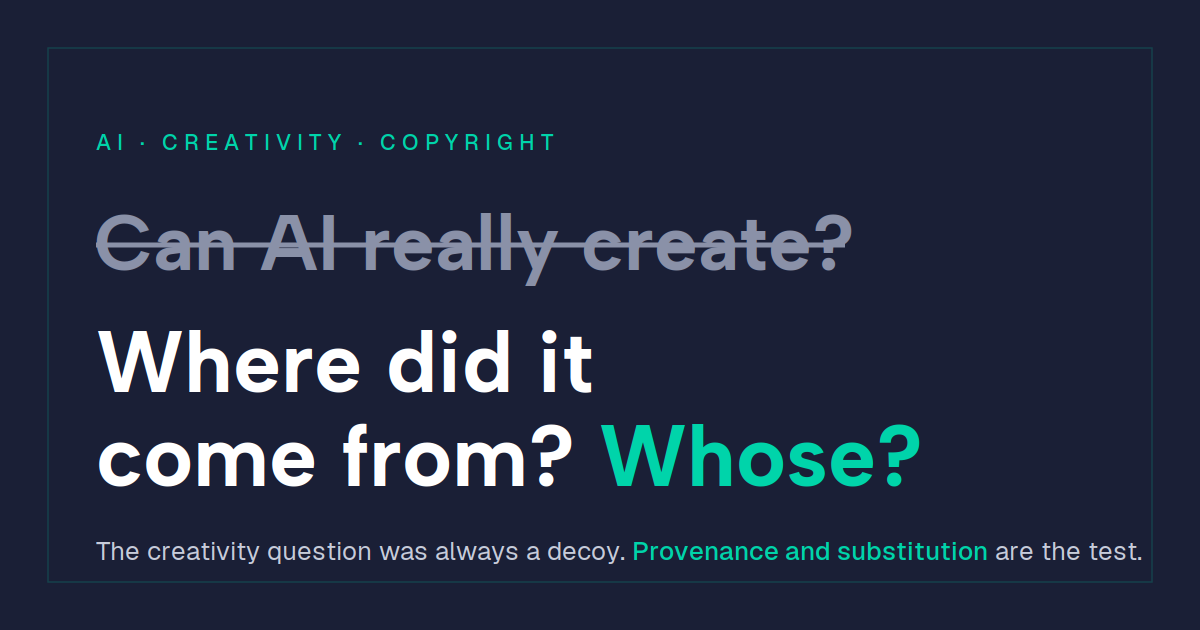
That is the whole game, and it has nothing to do with creativity. The line these rulings reached for was between material you came by honestly and material you took, and between output that adds something new and output that eats the original's lunch. Provenance and substitution. Everything else was theatre.
This is where I'll plant a flag. The creativity question is a decoy, and we should stop dignifying it. "Can AI really create?" is unanswerable, and worse, it is irrelevant to every decision a working person has to make.
It is status anxiety wearing the costume of principle.
The questions that survive contact with reality are smaller, harder, and answerable: Where did the training data come from? Did the people who made it get to say no? And does the output displace the thing it learned from, or stand beside it?
Two continents, one buried agreement
America and Europe have answered differently, and the difference between them gives the game away.
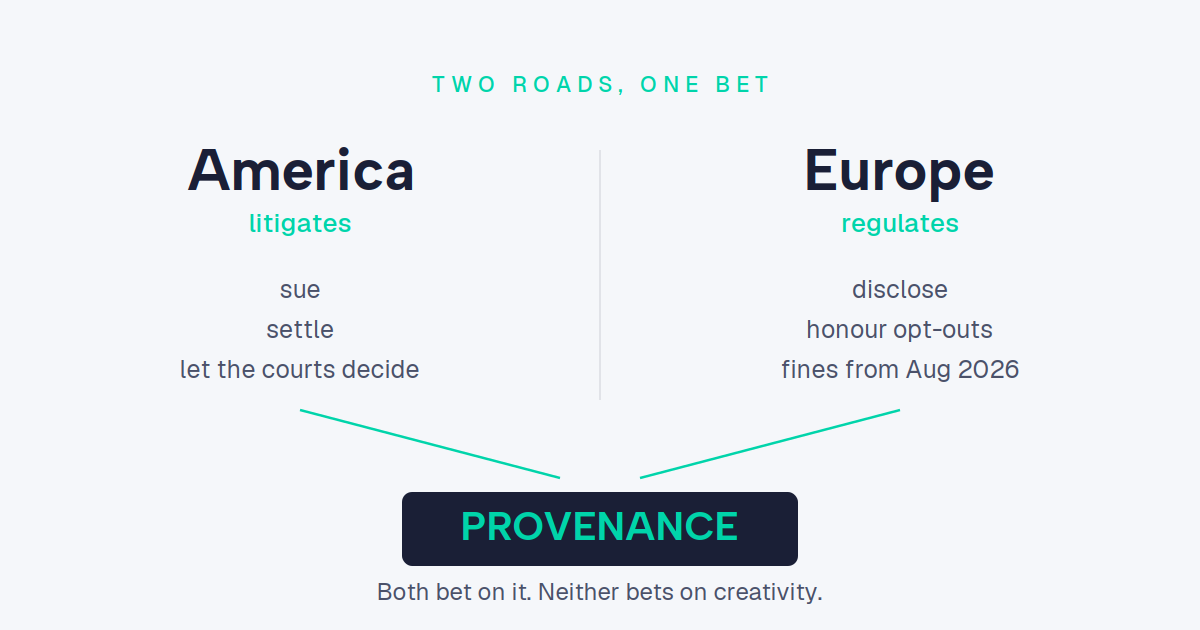
America litigates. Sue, settle, let the case law accrete one ruling at a time, and discover the rules only after the fact. Europe, since August 2025, regulates in advance: the AI Act now makes model providers publish a summary of what they trained on, keep a copyright policy, and — the provision that matters most — respect the rights reservations that European text-and-data-mining law lets rights-holders set against being scraped. The Commission's power to enforce it, fines included, switches on in August 2026.
My opinion, since that's what you came for: Europe's instinct is the better one, clumsy templates and all. Not because Europe is in love with rules. Because Europe is aiming, however awkwardly, at the right target — provenance and consent — instead of trying to legislate the existence of a soul. A disclosure-and-opt-out regime is a bet that the real issue is honesty of sourcing. A lawsuit is a bet that the real issue is theft. Both are bets on provenance. Neither is a bet on creativity. Underneath the noise, America and Europe are circling the same question. They just won't say so out loud.
If you actually run a business
If you operate a European company and you have started generating your marketing copy, your product images, your first drafts with these tools — and by now most of you have — none of this is abstract.
Your exposure was never "is my AI truly creative." It is the boring, answerable stuff. Can your vendor tell you what the model was trained on? Does any single output lean so heavily on one identifiable source that it stands in for it? Are you, without realising it, a deployer — and is your particular use of these tools one the Act actually has rules for, from disclosure duties at the light end to the high-risk regime at the heavy end? The provenance questions are the ones that surface in a contract dispute or a takedown notice. The creativity question never will.
There is a comforting line you hear at the end of essays like this one — that what really matters is whether the work touches some deep chord in the human soul. It is the same evasion in prettier clothes. The soul was never the test. The test was always whether you came by your materials honestly and whether you made something that can stand on its own. It held for Shakespeare, for Van Gogh, for the kid with a borrowed guitar in Liverpool, and it holds now for the model and the person at the keyboard.
So stop asking whether the machine is creative. It is the wrong question, and no answer to it changes what you owe.
The competence was never in the code. It was in knowing what to build with it — and in being able to say, without flinching, where you got the parts.
Fabio Lauria
CEO & Founder, ELECTE
Every week, we explore AI without the hype — using data, analysis and an independent perspective.
AI Frontiers · every Thursday
Subscribe to AI Frontiers.
Subscribe to keep reading.
The first essay was on us. The rest of this one is for subscribers. Read every essay and receive new editions by email. No payment required.
Comments ()