

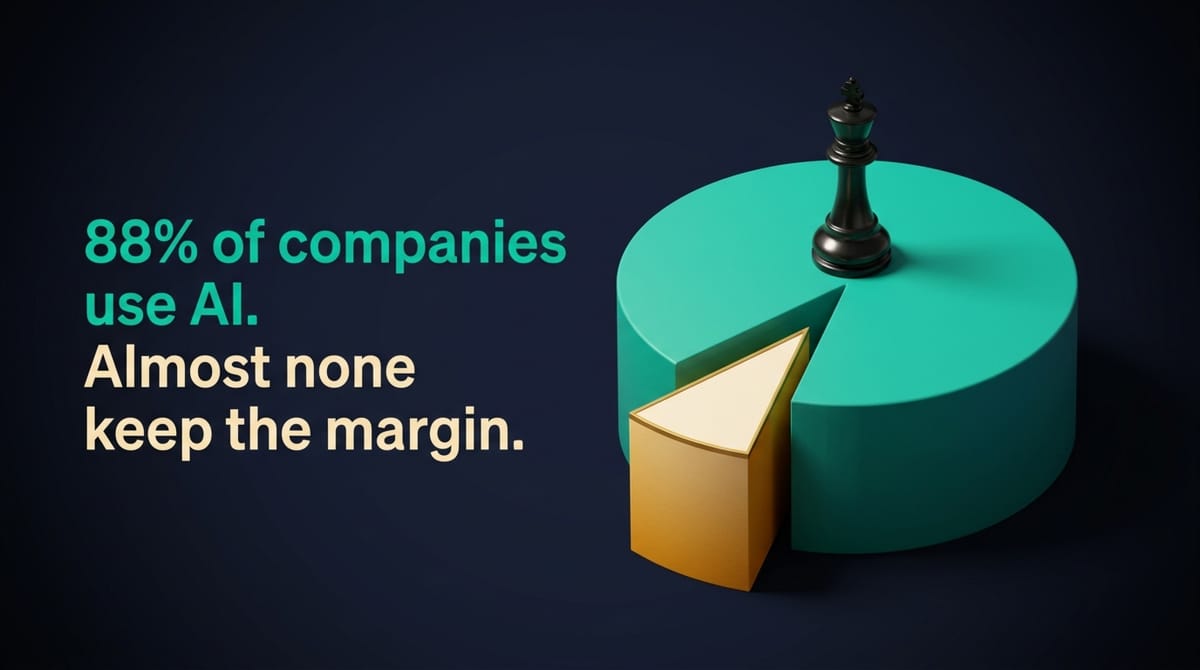
Most advice about AI for business strategy starts with the wrong decision: which model to deploy, which vendor to pick, which department runs the first pilot. The question that decides the economics is different: who controls the inputs, the contracts and the infrastructure that determine whether AI creates margin for the adopter or rent for its suppliers?
Adoption is now near-universal; value capture is still rare. In McKinsey’s latest global survey, 88% of respondents use AI in at least one business function, yet only 7% have fully scaled it across the enterprise, and the “AI high performers” — organisations attributing at least 5% of EBIT to AI — are about 6% of the sample. Two years earlier, after six years stuck at around 50%, adoption had jumped to 72%. The curve moved; the income statements, mostly, did not.
I read this as a political-economy problem. The winners will not be the firms with the most AI activity. They will be the firms that keep bargaining power, steer the gains to their own income statement, and retain the ability to change supplier when the economics shift.
I made this argument at length in a recent interview; the full conversation is below.
The interview: AI strategy, and who captures the value.
The strategy question nobody asks
Executives treat AI as a technology-adoption decision. That framing puts the model at the centre and the firm at the edge, as if the business only had to pick a capability and absorb it into existing processes.
AI strategy is a question of control over the operating model — data, workflow design, supplier terms, customer relationships, and how the resulting gains are distributed. What matters is who captures the margin when AI changes the cost of serving a customer, making a product or taking a decision.
Adoption can weaken the adopter
A business can automate a process and lose strategic power in the same move. If the automation rests on a proprietary API, rented compute and restrictive data terms, the firm has swapped labour dependence for infrastructure dependence. Its cost line improves for a while; the supplier gains usage data, controls the roadmap and keeps the right to change pricing or access.
The pattern is familiar from enterprise software and cloud. Downstream firms buy efficiency; upstream providers accumulate recurring revenue, behavioural data and negotiating power. The adopter gets faster without getting more defensible.
The strategic test: if a firm cannot move its data, models and workflows without operational disruption, it does not control its AI capability.
Margin is a governance outcome
Firms that capture value treat AI as a portfolio of operating-model changes, not a collection of licences. Before deployment they fix the baseline — cost, cycle time, error rate, decision outcome — assign responsibility for the result, and negotiate the terms that decide whether the capability survives a change of supplier.
Procurement, legal review and board oversight therefore sit inside AI strategy, not after it. The model is one component. Control over the surrounding system determines who receives the surplus.
Adoption is not advantage
Adoption figures look impressive while economic control sits elsewhere. Capgemini found that 80% of organisations increased their generative-AI investment compared with 2023, and 24% had integrated the technology into some or most operations, up from 6% a year earlier. Expansion shows AI has moved past isolated experiments. It says nothing about whether the adopters have secured a defensible position — which is exactly the gap between 88% adoption and a 6% high-performer cohort in the McKinsey data.
Activity measures are easy to manufacture
A company can count pilots, active users and generated documents without proving its economics improved. These measures reward activity, not control, and they let suppliers define success through usage — pulling management’s attention away from the firm’s commercial position and from who keeps the surplus.
The two camps differ on three things:
- Primary signal. Broad adopters report usage across functions; value capturers report a measured change in EBIT, throughput, error rates or unit cost.
- Operating model. Broad adopters add tools to existing workflows; value capturers redesign linked processes around decisions and outcomes.
- Supplier position. Broad adopters carry high dependency on external infrastructure and terms; value capturers have negotiated portability, governance and switching options.
The metric gets more informative when it shifts from adoption to operating outcome. A U.S. firm-level analysis found a positive relationship between the breadth of AI integration and commercial performance, explained by operational complementarity: AI creates more value when linked tasks reinforce one another than when it runs as standalone tools. That does not establish that every broad deployment causes better performance. It does give strategy teams a better measurement system: track AI by business process and decision class, then compare throughput, error rates, latency and decision quality against a control baseline. Counting prompts tells management nothing about value capture.
Concentration beats enthusiasm
BCG reports that 60% of companies are reaping hardly any material value from AI despite substantial spending. The firms that do capture value direct more than 80% of AI investment at reshaping core functions and building new offerings, pursue 3.5 use cases on average against 6.1 for the rest, and expect 2.1 times the ROI.
The implication is portfolio discipline. A concentrated use case can be given data engineering, workflow redesign, training, governance and a commercial owner. A sprawling pilot list gets none of these for long enough to change the economics. AI adoption is strategically meaningful only when management can name the process affected, the result measured and the party capturing the gain. Without those three, rising usage may strengthen the supplier’s position more than the adopter’s.
Infrastructure concentration and bargaining power
The upstream market sets the limits of downstream strategy. Firms adopting AI depend on a small group of infrastructure owners for compute, cloud distribution and access to core models, and that dependence gives suppliers influence over prices, service continuity, technical standards and data movement before any contract is signed.
The OECD’s analysis of competition in AI infrastructure puts Nvidia’s share of GPUs used for AI at over 80% and the combined share of the three largest cloud providers at over 60%. Those figures measure nothing about any individual adopter’s profitability. They show where bargaining power is concentrated along the supply chain — the conditions inside which every corporate AI strategy is being designed.
Dependency becomes strategic exposure
A firm that builds a core workflow around one model interface can face high switching costs even where alternatives exist. The dependence sits in prompt formats, evaluation harnesses, fine-tuned weights, data schemas, staff training and downstream applications. A technical substitute is not automatically a commercial substitute.
European buyers face a further question about sovereignty and continuity. Regulated industries and public bodies may need clear provisions on data residency, auditability and service access; if the supplier controls the infrastructure and the buyer lacks portability rights, compliance obligations raise the cost of changing provider.
The structure is the one I described in the analysis of producer surplus and monopoly: ownership of a scarce input lets more value accrue upstream, especially when buyers cannot coordinate or switch easily.
Compute is also a contract problem
Concentration does not guarantee higher prices or harmful terms. It means buyers must assess their real alternatives before scaling. A strategy built on technical performance alone misses capacity costs, data-use rights, outage exposure and the expense of retraining staff around a replacement system.
Map the dependencies for every critical workflow: infrastructure provider, data owner, model dependency, portability mechanism, operational fallback. That exercise separates rented capacity from proprietary advantage, and it shows where a supplier can move your margins without changing its product.
Procurement as the strategic layer
The decisive AI choice may sit in a contract rather than a model catalogue. Procurement terms decide who may use the data, who owns fine-tuned outputs, how the buyer can audit the system, and what happens when the relationship ends. They shape value capture and bargaining power before deployment begins.
OECD guidance on AI in public procurement identifies weak regulation and thin procurement guidance as sources of legal ambiguity, and warns that poor data licensing creates data lock-in and vendor lock-in — systems that are less effective and harder to replace.
Default terms favour continuity
A standard contract treats portability as a technical detail. A strategic buyer treats it as a condition of control, because it decides future negotiating power, not only the mechanics of exit. The gap shows on four dimensions:
- Data. Default terms: restricted export, unclear reuse rights. Strategic terms: defined access, usable formats, clear ownership.
- Model outputs. Default: ambiguous treatment of fine-tuning and derived assets. Strategic: explicit rights to weights, prompts, evaluations and outputs.
- Exit. Default: transition assistance subject to availability or fees. Strategic: a tested transition plan, knowledge transfer and portability.
- Audit. Default: limited supplier disclosure. Strategic: auditability, incident reporting and supplier declarations.
The U.S. federal government now buys on the second column. OMB’s April 2025 acquisition memorandum, M-25-22, directs agencies to prevent vendor lock-in through knowledge transfer, data and model portability, clear licensing terms and pricing transparency. Public procurement is a useful indicator because governments buy at scale while defending continuity, accountability and lawful use.
Businesses should apply the same discipline. Before approving deployment, establish whether you can export your data, reproduce your evaluation process and run the workflow with another supplier — and assign the cost of model changes, declining performance or regulatory redesign before those events occur.
Governance belongs in the buying process
Security review alone cannot answer these questions. Commercial, legal, compliance and operational owners need to assess the dependency chain together, including information security and integrity: controls must hold under pressure, not rest on assurances made during a sales process.
The contract should also specify evidence and remedies — records of system changes, incident-reporting duties, audit access, and a defined route for transferring knowledge and data. These provisions turn governance from an approval ritual into a condition of continued use.
Contractual rule: never approve an AI dependency without defining the buyer’s exit rights before deployment begins.
Portfolio discipline over pilot sprawl
Pilot sprawl persists because activity is easy to report and value is hard to prove. A department launches an experiment, a supplier demonstrates a capability, management points to visible AI work. The harder test is whether the initiative has a credible route to production, a named economic owner, and a supplier structure that keeps a meaningful share of the gains inside the business. The BCG numbers above — concentrated investment, fewer use cases, higher expected returns — are the evidence for concentration over novelty.
Choose the bottleneck, not the novelty
A disciplined portfolio starts from economic pain: a costly delay, a recurring error, a constrained decision, a product opportunity where AI could change the firm’s position. Then it tests whether the organisation controls the data and can redesign the surrounding workflow. The screening sequence:
- Value at stake. What measurable outcome changes if the system works reliably?
- Integration burden. Which processes, roles and systems must change before the result matters?
- Defensibility. Would proprietary data, workflow knowledge or customer relationships make the capability hard to copy?
- Supplier exposure. Can the firm change model or infrastructure provider without losing the process?
- Kill criteria. What evidence would justify stopping?
The last question is usually omitted.
Without a kill criterion, a pilot gains political protection as the effort accumulates — and the supplier gains a customer who can no longer stop.
That gives suppliers every incentive to sell proof-of-concept activity rather than accept responsibility for production results.
Link the initiative to a decision owner
Every project needs one business owner accountable for the outcome, alongside any technical owner responsible for deployment. That person defines the baseline, approves the control group or comparison method, and reports results in commercial terms.
Faster adoption raises the cost of weak portfolio governance, because projects compete for the same data, engineering capacity and management attention. Reject initiatives that cannot show a production path, an accountable owner and a defensible source of value. A smaller portfolio also changes bargaining power: procurement and finance get clearer evidence about which dependencies deserve funding, renegotiation or removal.
Regulation reshapes the value chain
Regulation is changing who carries information, liability and compliance work across the AI supply chain. The EU AI Act assigns obligations by an actor’s role and a system’s risk profile — which makes it a value-chain issue, not a final legal check. Rules for general-purpose AI providers have applied since 2 August 2025; providers whose models were on the market before that date have until 2 August 2027.
Information becomes a bargaining asset
Disclosure, risk-management and documentation requirements cut into upstream providers’ information advantage. Buyers get clearer evidence about the systems they purchase; providers must show how they meet their obligations. That creates grounds to negotiate warranties, audit access, incident reporting and responsibility for remediation.
Compliance also raises entry barriers. Larger providers spread documentation, testing and governance costs across a broad customer base; smaller suppliers find them harder to absorb. So the political-economy result is mixed: buyers gain protection from opaque risk, and concentration may increase if compliance costs squeeze out smaller providers. Strategy has to account for both.
Risk allocation should be negotiated
A buyer should not treat the “deployer” label as a complete answer. Identify the obligations the intended use creates, determine which supplier representations are enforceable, and specify how responsibility shifts when the upstream model is updated.
This belongs in procurement, before production. Contracts should connect system classification, documentation, monitoring, incident response and exit rights, and specify access to records and remedies when a supplier’s change creates new compliance or operational exposure. Handled this way, compliance becomes part of bargaining power — it shapes price, liability and switching conditions instead of arriving as an administrative cost after the commercial terms are set.
Decision heuristics for operators and investors
AI strategy should be tested through falsifiable questions, not capability checklists. Who controls the critical input, who receives the margin, who pays when the assumptions fail.
For operators
- Control. Can the company export data, evaluation records and model-dependent workflows in a usable form?
- Margin. Does the initiative change an EBIT-relevant process, or mainly increase activity around a supplier’s product?
- Portability. Could another provider take over without rebuilding the operating process?
- Risk. Does the contract assign responsibility for inaccurate outputs, regulatory change and service interruption?
- Concentration. Would a change in infrastructure pricing or access terms materially alter the business case?
These questions convert AI adoption into an operating and bargaining analysis. A pilot that improves throughput but leaves data, evaluation and switching rights elsewhere creates activity without durable control. Workforce planning belongs in the same assessment: if AI changes which tasks enter the employment pipeline, examine skills, supervision and internal mobility rather than treating labour as a residual cost — the lens I applied to computer programming jobs.
For investors
Map a target’s position in the value chain before accepting an AI growth narrative. Does the company own scarce data or rent model access? Can it pass infrastructure costs to customers? Does gross margin depend on a supplier whose terms it cannot influence? The model should test how costs move when the firm switches provider, how quickly customers can leave, and whether compliance requirements strengthen or weaken its position. The distinction is between reported adoption and retained value: deployment alone does not establish durable returns, so examine renewal terms, customer concentration, usage-linked costs and the firm’s ability to renegotiate access.
For policymakers
Ask whether procurement rules require interoperability, data portability and meaningful supplier disclosure. Those measures reduce dependence on concentrated infrastructure owners, especially where public bodies are anchor customers, and they decide whether public demand reinforces incumbents or makes room for alternatives. The test: does the policy increase the number of credible alternatives available to buyers, or does it make incumbent compliance capacity more valuable? That separates formal governance from effective competition.
An AI strategy is credible when each major claim survives these tests. If the value case depends on permanent supplier access, unpriced compliance work or unmeasured workflow change, the board is not approving a strategy. It is approving exposure.
Sources
- McKinsey, The state of AI in 2025: Agents, innovation, and transformation
- McKinsey, The state of AI in early 2024
- Capgemini survey via TechTarget
- U.S. Census Bureau CES, firm-level analysis of AI integration
- BCG, Are You Generating Value from AI? The Widening Gap
- OECD, Competition in artificial intelligence infrastructure
- OECD, Governing with AI — AI in public procurement
- OECD.AI, OMB Memorandum M-25-22
- European Commission, AI Act regulatory framework
Fabio Lauria
CEO & Founder, ELECTE
Every week, we explore AI without the hype — using data, analysis and an independent perspective.
AI Frontiers · every Thursday
Subscribe to AI Frontiers.
Subscribe to keep reading.
The first essay was on us. The rest of this one is for subscribers. Read every essay and receive new editions by email. No payment required.
Comments ()