
The AI monopoly price you don’t see
AI can stay cheap—or free—while data, prediction and switching costs quietly change who captures the value.
That is the uncomfortable update AI brings to one of economics' oldest diagrams.
The textbook monopolist raises prices, restricts output and takes a larger share of the surplus created by a transaction.
But what happens when the product costs nothing?
What happens when the price stays low — yet every interaction generates information, every integration makes switching harder, and every year of use makes the relationship more difficult to reproduce somewhere else?
The monopoly problem has not disappeared. The extraction mechanism has changed.
In AI markets, the important question is no longer only:
What did you pay?
It is also:
What did you surrender, what did the provider learn, and how expensive would it be to leave?
The Textbook Monopoly Still Matters
Start with the familiar model.
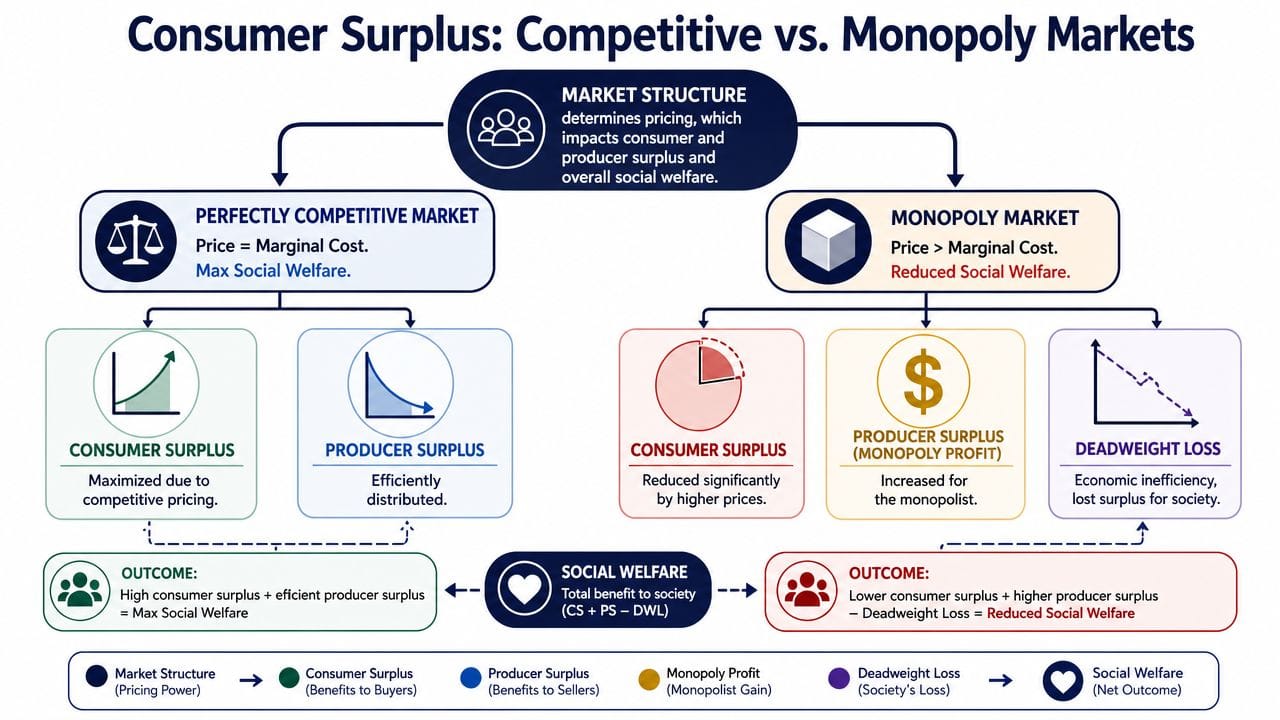
Consumer surplus is the difference between what a buyer would have been willing to pay and what they actually pay.
Under competition, rivalry tends to push prices down and output up. More transactions happen. More of the value created by those transactions remains with consumers.
A single-price monopolist changes that bargain.
It restricts output, charges more and captures part of the surplus that would otherwise have remained with buyers.
Two things happen.
Surplus is transferred. Consumers who still buy pay more, shifting part of their previous surplus to the producer.
Surplus is destroyed. Some transactions no longer happen at all, creating deadweight loss.
That distinction matters.
Monopoly is not simply a question of whether companies make "too much" money. The deeper economic problem is that market power changes both who receives the value and how much value gets created in the first place.
For industrial markets, the price tag made much of this visible.
Digital markets make it harder to see.
Now Remove the Price Tag
Imagine the same market with a consumer price of zero.
The old diagram suddenly becomes less intuitive.
A search engine can be free.
A social network can be free.
A chatbot can be free.
An AI assistant can arrive as one more feature inside software a company already pays for.
The temptation is to conclude that consumer surplus must therefore be enormous.
Sometimes it is.
But zero monetary price is not the same thing as zero economic exchange.

Users can still give up something valuable:
- information about their behaviour,
- attention,
- privacy,
- contractual rights,
- control over accumulated context,
- interoperability,
- or the practical ability to switch provider later.
That does not mean we should simply declare that "data is the new price."
The economics is more interesting than that.
Data can genuinely improve a product. Personalisation can save time. History can make an assistant more useful. Integrations can remove work.
The problem appears when those improvements also make the provider progressively harder to replace.
The monetary price can remain at zero while the terms of the relationship become more valuable to the firm.
AI Creates a Second Transaction
This is where AI changes the picture.
With a conventional product, the transaction is fairly easy to recognise.
You buy something.
The supplier delivers it.
With AI, there can be another exchange running alongside that one.
The user gets an answer.
The system gets an interaction.
A prompt can reveal intent.
A correction can reveal what the system got wrong.
A repeated sequence can reveal a workflow.
Accepted and rejected outputs can reveal preferences.
An uploaded document can reveal context.
An integration can reveal how different parts of an organisation work together.
Not every provider trains its underlying model on every interaction. Consumer products, APIs and enterprise contracts differ substantially, and the distinction matters.
But model training is only one way interactions can create value.
They can also support product analytics, evaluation, personalisation, ranking, interface design, segmentation and better understanding of how customers actually use the system.
The economic chain can therefore look like this:
USE → INFORMATION → INFERENCE → BETTER PRODUCT → DEEPER DEPENDENCE
And eventually:
DEEPER DEPENDENCE → STRONGER BARGAINING POWER
I explored the information side of this in Whether You Like It or Not, Your Data Will Fuel AI. The important distinction is that the valuable asset is rarely one isolated prompt.
It is what can be inferred from repeated participation.
The platform does not need every interaction to be valuable on its own. It needs millions of interactions to become valuable together.
That is where scale matters.
A single correction is noise.
Millions of corrections can reveal where systems fail.
A single workflow says little.
Thousands of similar workflows can reveal what customers need next.
A single preference is trivial.
Aggregated preferences can improve prediction.
The user experiences consumption.
The provider may also accumulate knowledge.
The Real Moat Is What Doesn't Travel
Now imagine using an AI system for three years.
During that time, your organisation builds around it.
There are conversations.
Prompt libraries.
Agents.
Permissions.
Uploaded documents.
Automations.
Integrations.
Evaluation criteria.
Employee habits.
Maybe the underlying model itself is eventually surpassed by a competitor.
Can you actually move?
That is a different question.
A competing model can become better without making the competing system easier to adopt.
The economically important asset may no longer be the model.
It may be everything accumulated around it.
The export illusion
Suppose the provider lets you download all your files.
Technically, your data is portable.
But what about:
- conversation history,
- system instructions,
- agent state,
- embeddings,
- integration logic,
- evaluation history,
- permissions,
- metadata,
- workflow relationships,
- personalisation,
- and the behaviour employees have learned to expect?
If those cannot be reconstructed elsewhere, the user may legally own the underlying data while still being economically locked in.
That gives us a better test than asking whether an "export" button exists.
The exit test
If I leave tomorrow, how much of the value I created here comes with me?
That is the question procurement teams should be asking before the relationship begins.
Because the cheapest AI system today can become the most expensive one tomorrow if leaving requires rebuilding everything around it.
The competitive problem is therefore not merely data ownership.
It is contestability.
Can another provider realistically compete for the customer after several years of accumulated use?
Or has the relationship itself become the moat?
Your Data Isn't the Surplus. What It Reveals Can Help Capture It.
This distinction is important.
The original digital-economy argument often collapses several things into one sentence:
"If the product is free, you are the product."
Catchy.
But economically imprecise.
The user can receive substantial value from a free service. The provider can receive substantial value from the relationship. Both things can be true simultaneously.
The more interesting question is whether one side gains an informational advantage that allows it to capture a progressively larger share of the value later.
Think about what repeated observation can reveal.
Who is price-sensitive?
Who urgently needs a feature?
Which company has deeply integrated the service?
Which user is unlikely to switch?
Which customer cannot tolerate downtime?
Which organisation has reached the point where migration would be painful?
This is where data stops being merely an input to a better product.
It can become an input to better bargaining.
Algorithmic Rents: Knowing What You Will Tolerate
The textbook monopolist charges one price.
A data-rich monopolist can potentially do something more sophisticated.
It can segment.
It does not need perfect knowledge of everyone's willingness to pay. It only needs enough information to distinguish customers who behave differently.

That segmentation does not have to appear as a personalised price flashing on your screen.
It can emerge through:
Bundling. The useful combination of features exists only in a higher tier.
Feature gating. Interoperability, administration, speed or control becomes available only above a certain price.
Retention pricing. Different customers receive different incentives depending on the probability that they leave.
Usage architecture. Limits are positioned around the behaviour of particular customer groups.
Enterprise negotiation. The provider knows far more about how dependent the customer has become than a simple public price list reveals.
Contract duration. Discounts can exchange a lower visible price for a longer period of dependence.
Now an important qualification.
More segmentation does not automatically mean consumers are worse off.
The economics of price discrimination is more conditional than that.
Research by Bergemann, Brooks and Morris shows that additional information and market segmentation can generate very different distributions of consumer and producer surplus. More recent work by Bergemann, Heumann and Wang similarly shows that the consumer effect depends on the structure of demand and costs.
That is precisely why the economics of monopoly pricing and segmentation matters here.
The point is not:
More data always hurts consumers.
The point is:
More information changes what the seller is capable of learning about demand — and therefore what it is capable of extracting from it.
The most powerful monopoly may not be the one that posts the highest price. It may be the one that knows which terms each customer will tolerate.
A Better Way to Think About AI Monopoly Power
Put the pieces together and the mechanism becomes clearer.
1. Cheap access attracts participation.
A free or subsidised product can maximise adoption.
↓
2. Participation generates information.
Usage reveals preferences, workflows, failures and dependencies.
↓
3. Information improves prediction.
The provider understands the product and its customers better.
↓
4. The system accumulates context.
Integrations, history and organisational habits become harder to reproduce elsewhere.
↓
5. Switching becomes more expensive.
The alternative no longer needs to be merely "better." It needs to be better enough to justify migration.
↓
6. Bargaining power changes.
The provider gains more room over pricing, bundling, contracts and product terms.
That is a very different monopoly story from simply:
Price goes up. Quantity goes down.
But the underlying economic question is the same.
Who gets the surplus?
Consumer Benefit Does Not Disprove Market Power
This point is worth making explicitly because technology debates often collapse into a false choice.
Either:
The product benefits consumers.
Or:
The firm has too much market power.
Both can be true.
An AI service that costs €20 a month and saves a professional ten hours of work can generate enormous consumer surplus.
A free product can improve millions of lives.
A dominant platform can innovate.
None of those observations tells us how the gains created by that innovation will eventually be divided.
That is the monopoly question.
Under strong competition, providers have incentives to return more of those gains to customers:
lower prices,
better products,
more generous terms,
stronger privacy,
better portability,
or easier interoperability.
When customers have few credible alternatives, the provider has more room to retain the gains.
Creating value and capturing value are different questions.
AI may become extraordinary at the first while simultaneously changing the balance of the second.
Regulation Has to Look at the Extraction Architecture
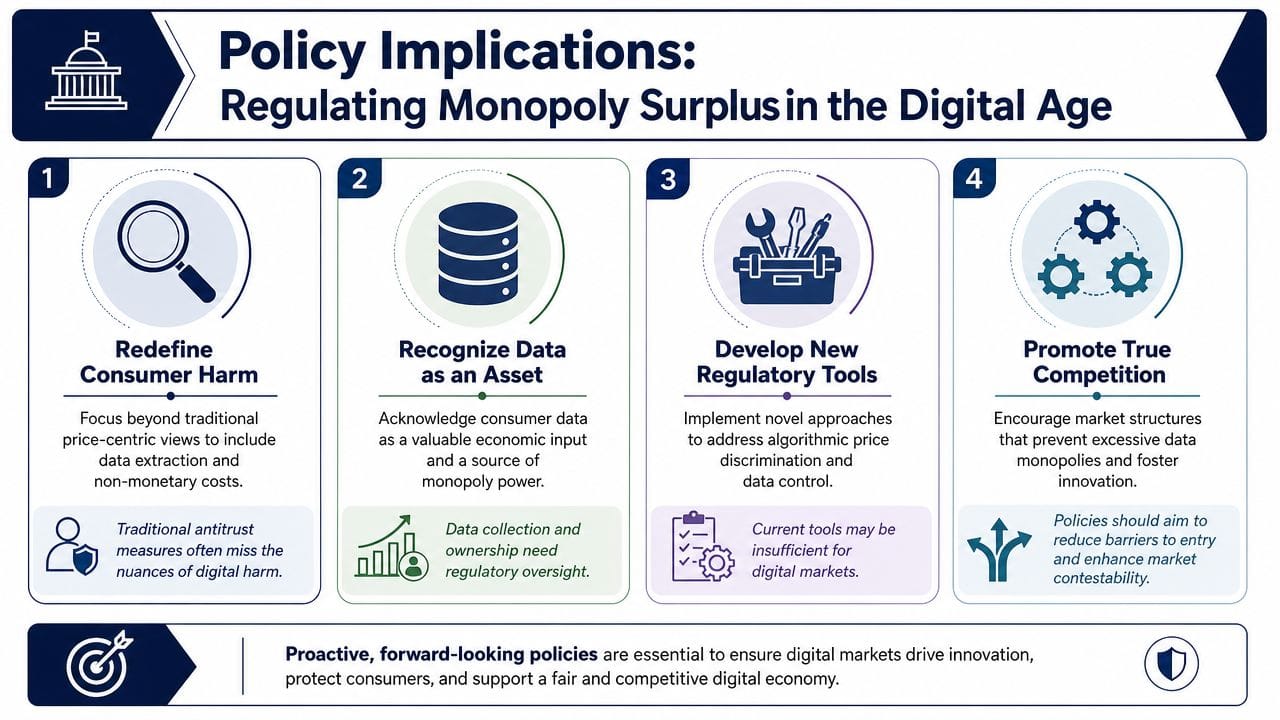
If that diagnosis is correct, competition policy cannot focus only on visible prices.
A free service can still create competition problems.
A cheap service can still create lock-in.
A merger can matter even when nobody intends to increase the subscription price next quarter.
The more useful questions are structural.
Can the customer leave?
Not theoretically.
Practically.
Can history, context and workflows move to another provider without being rebuilt from scratch?
Can another provider interoperate?
Formal data ownership means little if the information cannot be used effectively elsewhere.
What do the contracts allow?
Data-use clauses, derived information, retention terms, APIs, interoperability and termination rights can affect competition just as meaningfully as headline price.
What becomes harder for competitors to reproduce?
When companies combine datasets, distribution, infrastructure or customer relationships, the important competitive effect may not appear immediately on an invoice.
It may appear as a stronger moat.
This is also why the debate is larger than privacy.
Privacy asks:
What may a company know about me?
Competition asks another question:
What can the company do because it knows it?
And those questions increasingly overlap.
The same broader bargaining issue appears in a different form in The Pay-Per-Crawl Revolution: How Publishers Can Monetize AI Traffic. Once an intermediary controls access and has enough information about the parties on both sides, control of the channel itself becomes economically important.
The Procurement Question Nobody Asks Early Enough
For businesses adopting AI now, there is a simpler lesson.
Do not negotiate only over today's price.
Negotiate over tomorrow's exit.
Before adopting a system that could become embedded in operations, ask four questions.
What accumulates?
What history, context, configuration and derived information becomes more valuable as the relationship continues?
What travels?
What can actually be exported in a form another provider can use?
What survives termination?
What does the supplier retain? What do you retain? What disappears?
What can be reconstructed elsewhere?
Could another provider realistically reproduce the service using what you are able to take with you?
That final question is the one I would put in every serious AI procurement process.
Because data ownership without practical substitutability can still leave the customer captive.
The Monopoly Price You Don't See
The textbook monopoly diagram is not wrong.
It is incomplete.
Its fundamental insight still holds: market power changes how the gains from exchange are divided.
What AI changes is the number of instruments available to make that transfer.
The firm can raise the price.
But it can also accumulate information.
Improve prediction.
Control distribution.
Design bundles.
Restrict interoperability.
Increase switching costs.
Or allow years of valuable context to accumulate somewhere customers cannot easily reproduce.
The most consequential transfer may therefore happen while the headline price does not change at all.
The customer still gets a useful product.
The provider still creates genuine value.
But with every interaction, the relationship can become more valuable to the provider — and more expensive for the customer to abandon.
That is the digital update to consumer surplus in monopoly.
The question is not whether the service is free.
The question is whether you remain free to leave.
If this is the kind of analysis you want more of, subscribe to AI Frontiers by ELECTE.
Sources
- Single-price monopoly pricing and the reduction of consumer surplus
- Consumer surplus loss through non-price monopoly mechanisms
- Preference data, privacy, and monopoly surplus extraction
- Monopoly pricing, segmentation, and consumer and producer surplus
Fabio Lauria
CEO & Founder, ELECTE
Every week, we explore AI without the hype — using data, analysis and an independent perspective.


Comments ()