

In March I argued two things: that headline "AI layoffs" in the US are often capital-allocation stories — Oracle planning cuts while carrying $108bn of debt, Amazon announcing roughly 30,000 corporate cuts while ending 2025 with 51,000 more employees than it had at the end of 2023 — and that the deeper shift happens through jobs that are never created: entry-level hiring in European tech down 73% in a year, without a single layoff.
Both pieces left the same question unanswered: what does the company look like when that process reaches its logical conclusion?
This time I am leaving reportage and making a forecast. The company I am about to describe does not exist at scale today. But the labour-market data is beginning to describe its outline.
One number predicts the rest
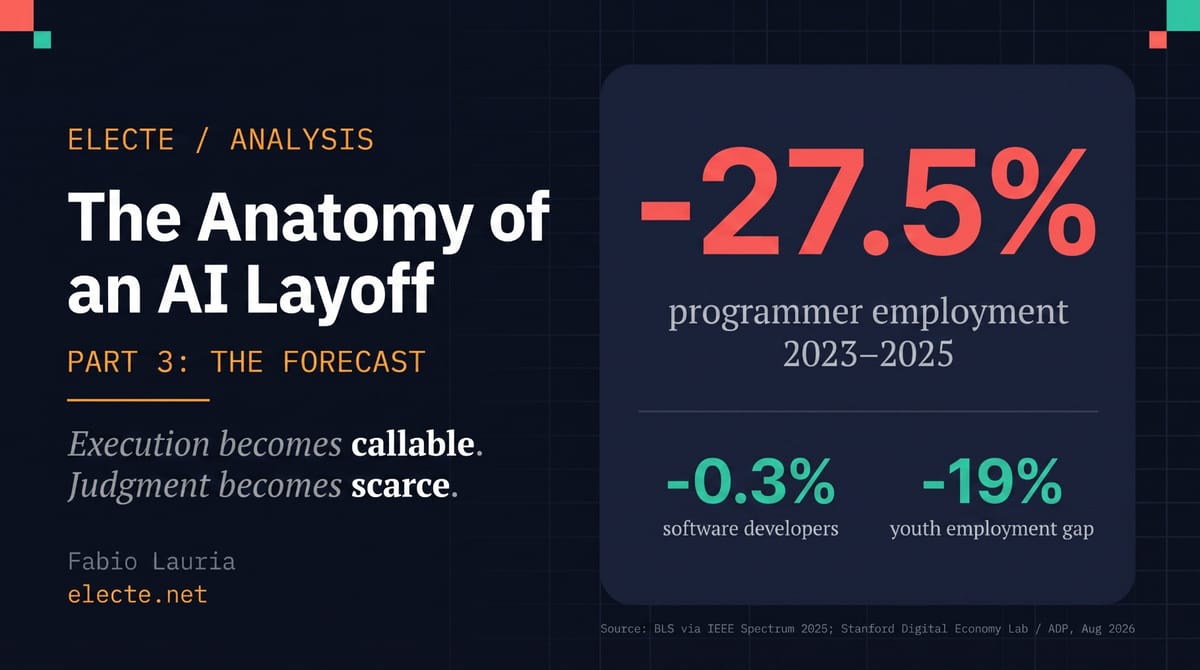
The most predictive statistic in this entire series comes from the BLS, via IEEE Spectrum: between 2023 and 2025, employment for programmers — people who write code from someone else's specification — fell 27.5%. Employment for software developers — people who decide what to build and how — fell 0.3%.
In everyday language the two titles blur into one job. In the BLS taxonomy they are separate occupations — and the market is now separating them far more sharply than language ever did. Job titles have been slowly migrating from "programmer" toward "developer" for years; that slow migration does not produce a 27.5% drop in twenty-four months.
Same industry. Same technology. A ninety-fold gap.
| Role | Core of the job | Employment 2023–2025 |
|---|---|---|
| Programmers | Write code from someone else's specification | −27.5% |
| Software developers | Decide what to build and how | −0.3% |
The more executable the work, the faster it disappears. The more judgment it requires, the more it stays.
Extend that line and the prediction for software is specific: the developer does not disappear as a person. The developer disappears as a headcount category — and survives as a function: anyone on the team with enough context can invoke it. Describe the outcome, an agent produces the artifact, a human reviews it.
That much the data already gestures at. My forecast is that the same mechanism spreads to the designer, the analyst, the copywriter — every role whose core is executing a well-specified task.
There is precedent for half of this. Most software developers no longer work directly in assembly, yet programming did not disappear; it moved up a layer of abstraction. The forecast is that this time the layer moves past the specialist entirely — the unit of work stops being an artifact written by hand and becomes an outcome described in language, which means the people who can originate change are no longer only the people who can produce the artifact.
The company at the end of the curve
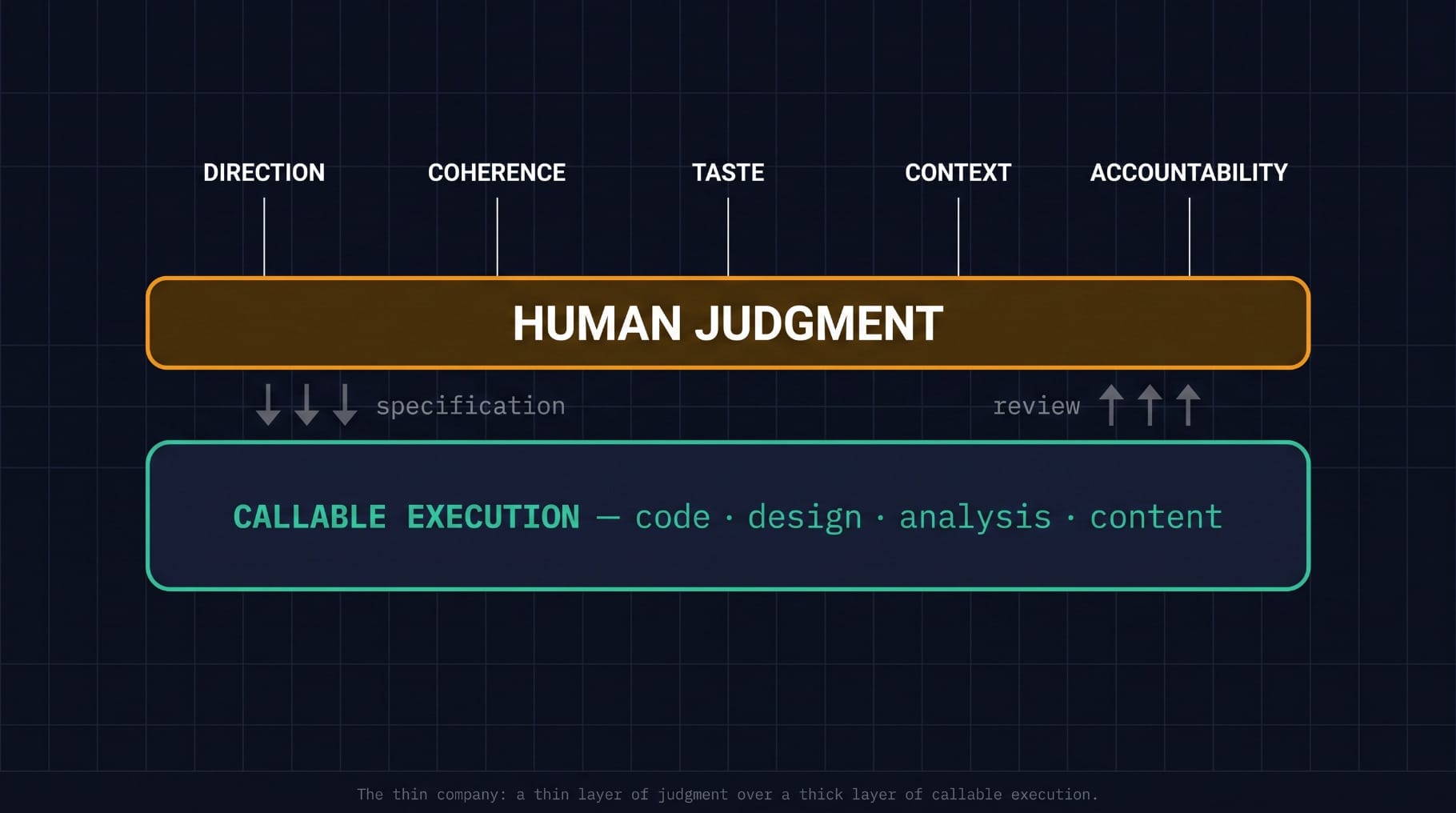
If execution is callable, the company is no longer assembled around functional specialties that own the doing. It is assembled around what agents cannot yet absorb reliably. Five responsibilities, essentially:
Direction. Deciding what is worth building and why — priorities, constraints, success criteria. When everyone on the team can ship, the scarce skill is knowing what should be shipped.
Coherence. A small number of deep technical people who own the shape of the systems. They write little of the code; they define the guardrails and the architectural invariants. Without them, a flood of agent-generated changes produces local successes and global decay.
Taste. Agents generate endless variants. Someone has to define — and continuously enforce — what "good" means for this company: the quality bar, the voice, the things that are never compromised.
Context. Deep, hard-to-encode knowledge of the specific problem space — users, regulations, edge cases, institutional history. Agents are powerful generalists; this is precisely what they miss. It is also the role most readers of this newsletter already occupy.
Accountability. Named humans who answer for outcomes — legally, to customers, to regulators — and who decide the autonomy boundaries: what agents may do without review, and what requires sign-off.
Plus one genuinely new function: maintaining the agent layer itself — shared context, permissions, evaluation, cost control. That shared context becomes the institutional memory: new humans and new agents orient from the same source of truth. The platform role of this decade.
The arithmetic that follows: a product organization once assembled from separate engineering, design, product and analytics teams can run with a much smaller human core directing a large layer of machine execution. The org chart flattens into outcome-based pods rather than functional silos. And the hiring profile inverts — the person worth hiring is no longer the executor, but the one who can specify tightly and evaluate rigorously.
| Old company | Thin company | |
|---|---|---|
| Chain | Expertise → specialist → execution → artifact | Context + judgment → specification → callable execution → review |
| Scarce input | Execution capacity | Specification and review capacity |
| Org unit | Functional department | Outcome-based pod |
| Hiring profile | The executor | The specifier-evaluator |
| Institutional memory | In people's heads | In the shared agent context |
One design decision becomes existential in this configuration: because anyone can invoke execution, the company must decide in advance where human review is mandatory, where sampling is enough, and how exceptions surface. Get that wrong and quality does not degrade — it collapses.
A preview — and why scale amplifies it
ELECTE already operates a version of this model: a small human core directing automated pipelines that produce code, multilingual content, video, podcast production and reporting — work that a few years ago would have required a separate specialist hire per function. It is a preview at small scale — but the logic bites harder at 500 people, not softer. Scale creates more execution, but also more coordination around that execution: planning, reporting, handoffs, approvals and management layers whose reason for existing changes when execution becomes callable. And this forecast stops deliberately at digital execution; automation of physical work would extend the argument, not weaken it.
The difference is the path. New companies are born in this configuration. Incumbents converge on it the way part two described: not by redesigning the org chart, but by ceasing to refill it. Either way, the constraint points the same direction: the scarce input is no longer execution capacity. It is specification and review capacity.
What would break the forecast
Three counterweights, because a forecast that cannot be proven wrong is not a forecast.
A Jevons-style rebound. If software becomes dramatically cheaper to produce, companies may simply produce much more of it. The end state could therefore mean more total systems — and potentially more total people — operating at a radically different leverage ratio.
Review is the real bottleneck. Agents produce plausible output in volume. Catching the non-obvious failure — the security hole, the architectural drift — still requires people who deeply understand the system. If review capacity does not scale, the thin human layer thickens back out of necessity.
The markers to watch. By 2028–2030, this forecast implies measurable signals: the entry-level share of hiring continuing to fall; senior-to-junior compensation gaps widening; revenue per employee rising sharply at AI-native firms; and specialist postings shifting from production toward architecture, integration and review. If that does not happen, the forecast was wrong.
One layer further out. The counterweights themselves have a half-life. The boundary between what agents cannot absorb and what becomes callable has moved in one direction every year since 2022. Parts of review, parts of orchestration, eventually parts of taste will cross it. The company described here is not an endpoint — it is the shape of the organization at the current frontier, and each time the frontier moves, the thin layer gets thinner. Which makes the question of where judgment comes from more acute, not less.
| Marker | Confirms the forecast | Refutes it |
|---|---|---|
| Entry-level share of hiring | Keeps falling | Recovers |
| Senior-to-junior compensation gap | Widens | Stable or narrows |
| Revenue per employee at AI-native firms | Rises sharply | Tracks industry average |
| Specialist job postings | Shift toward architecture, integration, review | Production roles persist |
The assumption with an expiry date
Here is the part that should worry you more than the org chart.
The company I have described runs almost entirely on senior judgment — direction, architecture, taste, accountability. Every one of those is a skill people historically built by doing the junior work first. And the data shows, in the present tense, that the junior work is disappearing: entry-level hiring down 73% in European tech, a 19% employment shortfall for 22–25-year-olds in highly AI-exposed occupations relative to their less-exposed peers — a gap driven primarily by reduced hiring, not layoffs — and automatable tasks stripped from postings before a human ever applies.
The thin company does not rebuild the ladder. It assumes people who already climbed it. Today that population exists: seniors trained in the pre-agent economy. It is a stock, not a flow — and it depletes through retirement on one side and non-replacement on the other.
There is a compounding effect I documented in The B+ Trap: as AI-assisted execution converges toward uniform quality, judgment becomes the only remaining competitive differentiator — at precisely the moment its production line is being shut down.
In the second article I wrote that if the first rung doesn't exist, neither does the ladder. The extreme consequence is a company built entirely of top rungs — staffed by a generation trained in a system the company no longer maintains.
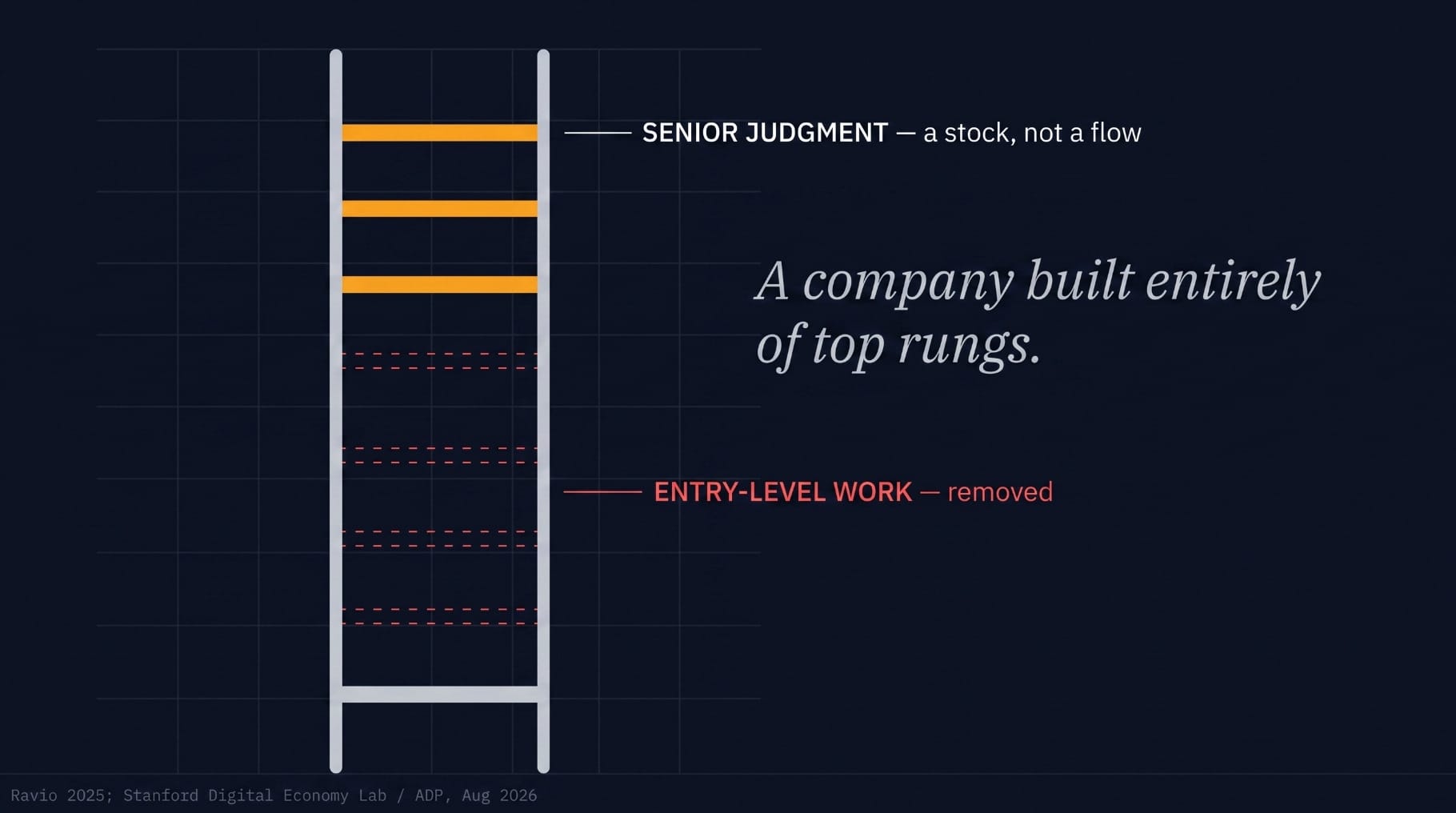
It works — brilliantly — for exactly one generation.
This article is the third in a series on how AI is restructuring the operational architecture of businesses. Part one — Layoffs Are the Headline. Hiring Collapse Is the Story — covers the US market; part two — Layoffs Make Noise. Hiring Stops in Silence — covers Europe. For a deeper operational analysis, see the white paper: AI for European SMEs: The 2026 Playbook.
Sources:
BLS / IEEE Spectrum, "How AI Is Reshaping Entry-Level Tech Jobs," December 2025 (programmers vs. software developers employment series)
Ravio, early-career hiring data, European tech market 2025 (P1/P2 hiring −73.4%)
Brynjolfsson, Chandar, Chen — "Canaries in the Coal Mine?", revised August 2026, Stanford Digital Economy Lab / ADP (19% employment shortfall, ages 22–25, highly AI-exposed occupations, driven primarily by reduced hiring)
Revelio Labs, AI-exposed task composition in job postings (2022–2025)
Amazon, Oracle — SEC filings, as analyzed in part one of this series
Lauria, F., "The B+ Trap," DOI 10.13140/RG.2.2.10486.46403
Fabio Lauria
CEO & Founder, ELECTE
Every week, we explore AI without the hype — using data, analysis and an independent perspective.
P.S. — A fix is possible; markets rarely leave a scarce input unproduced forever. But the old ladder was subsidised by productive junior work. If that work disappears, someone will have to pay explicitly to manufacture judgment. Who does — and why — is the next question.
AI Frontiers · every Thursday
Subscribe to AI Frontiers.
Subscribe to keep reading.
The first essay was on us. The rest of this one is for subscribers. Read every essay and receive new editions by email. No payment required.
Comments ()