
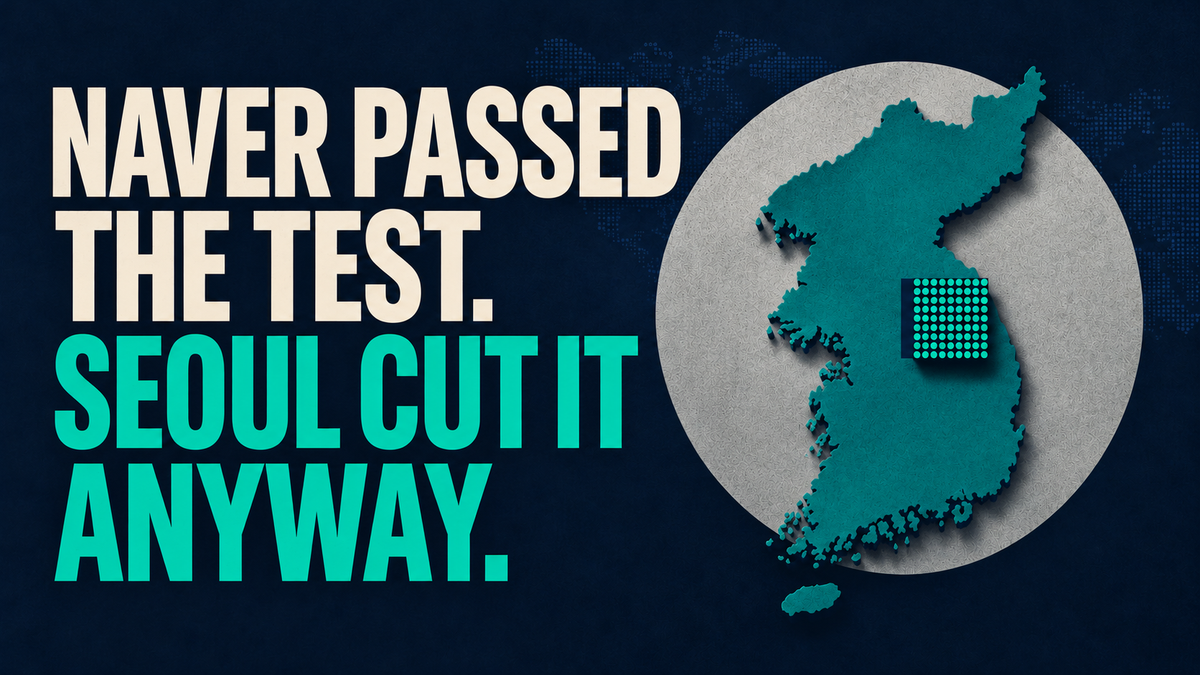
On 15 January, South Korea's science ministry announced the first-round results of its competition to build a sovereign AI model. Naver Cloud had passed the quantitative evaluation. It was out anyway. The part that cost it a place was the one that lets its model see.
On Tuesday, one of the remaining teams announced a deal, signed in Seoul, with a Canadian company. Upstage and Cohere plan to offer Upstage's Solar models and document software through North, Cohere's enterprise platform. A bank could run the combined system on its own premises and keep its customers' paperwork there. The two companies call that sovereign AI. A bank's compliance officer could explain what the word buys in a sentence.
Seoul had a more ambitious aim for its public money. It wanted Korean engineers to be able to build the next generation of models themselves. I can see the case for that. It gets harder when you get down to the part Naver actually used.
The part Naver borrowed
Give a model a photograph of an invoice and its vision encoder turns patches of the image into numbers the rest of the model can use. Naver chose the encoder from Alibaba's Qwen family, including the numerical values, or weights, it had learned during training. Naver said the component was proven and compatible with the wider ecosystem of AI tools.
Borrowing a vision encoder isn't grand theft. Seoul still treated it as disqualifying.
Naver had permission to use the encoder. The ministry's rules also allowed a team to use a published design. To qualify, though, the team had to reset the weights and train the model independently. In practical terms, Naver could borrow the design of the part that reads the invoice. Its engineers had to teach that part to see for themselves.
There is a public benefit to paying a second team to learn how to do something. When the next model needs building, the country has people who have done the work. But Naver said it already had a vision encoder of its own and could switch to it. That claim leaves room for doubt about how good its encoder was. It also leaves room for doubt about how much its engineers would have learned by training another. The ministry's decision tells us which encoder went into the submission. It gives us little basis for judging the value of repeating the work.
Naver declined to reapply. The open slot went to Motif Technologies, a startup the ministry praised in February for designing its own core modules. By August, Motif had the highest benchmark score of the four teams and finished fourth overall once the expert and user assessments counted. Two rounds, two capable teams out. In each case the scorecard tells you what Seoul valued. To see what the programme could deliver, I'd look at one of the teams that stayed in.
New in The ELECTE Quarterly
The autumn 2026 issue of The ELECTE Quarterly, The Art of Detecting Anomalies, is out now. In issue No. 02, we explore how machine learning and time-series analysis help teams distinguish ordinary variation from patterns worth investigating.
What a Korean chip did for Daum
In July, the Daum search portal was already serving AI summaries using Upstage's Solar model on chips designed by Korea's FuriosaAI. Daum's operator said the summaries appeared on roughly one in five searches at the time. The ministry's August evaluators singled out the deployment. They could point to a Korean processor running a Korean model under the load of a search service people used every day.
Those chips were serving answers. Training is a separate job, and Upstage lists NVIDIA B200 GPUs as the training hardware for its Solar Open 2 model. Foreign inputs extend to the training material. At an event in Seoul on 9 November, NVIDIA's vice president of applied research said all three remaining teams, Upstage, SK Telecom and LG AI Research, had drawn on datasets from its Nemotron family. Teams could train on examples assembled abroad. The provenance of the resulting weights was where the programme drew the line.
This is where Korea's memory business puts sovereignty in perspective. In the second quarter of 2026, SK hynix earned 50% of worldwide high-bandwidth memory revenue and Samsung earned 33%, according to Counterpoint. That memory feeds data to processors like NVIDIA's. Roughly five of every six dollars in that market went to two Korean firms. Yet when Korea planned its own computing expansion, it turned to NVIDIA. In October 2025 the company announced plans to deploy more than 260,000 GPUs across Korean public and private projects. The public-sector share was up to 50,000.
Daum gives that industrial story a result you can measure. Its engineers found a job a domestic chip could do and put real traffic through it. I'd have liked the ministry to be just as specific about the benefit it expected from training the encoder.
Which job would Korean engineers become able to do? How much public computing time was that ability worth?
The question for Europe
Europe already gives companies access to publicly funded computing time through the EuroHPC AI Factories. Suppose two teams apply for time on the same machine. One wants to train a vision encoder for European invoices. The other wants to use an available encoder and spend its allocation on the handwritten entries the software keeps misreading. I'd fund the first team if it could show that the encoder was where those mistakes began, or that training it would give Europe expertise it lacked. Either case would justify using some of a scarce allocation there. The word sovereign alone gives the people awarding the hours no way to choose.
Naver explained what it gained by using the existing encoder. Seoul explained why that choice broke the rule. What Korea stood to gain from the rule itself, nobody has spelled out.
Sources
- Korean Ministry of Science and ICT — first-round decision and independence criteria
- The Korea Herald — four teams met the quantitative criteria; Naver excluded on independence
- Asia Economy — Naver's account of the encoder and the ministry's decision
- Asia Economy — Naver says the encoder can be replaced with its own
- Asia Economy — ministry Q&A on the independence test
- Digital Today — Naver Cloud declines a second bid
- The Korea Herald — Motif selected in February
- MTN (Korean) — Motif's published benchmark, expert and user scores
- ZDNet Korea (Korean) — second-round results and the FuriosaAI demonstration
- Korea JoongAng Daily — Upstage and Cohere partnership, 17 November
- Aju Press — NVIDIA's account of finalists' use of Nemotron data
- Counterpoint Research — second-quarter 2026 HBM market share
- NVIDIA — October 2025 public and private GPU deployment plans
- Herald Economy (Korean) — Upstage's July deployment on Daum
- MTN (Korean) — Daum's July search coverage
- Upstage — Solar Open 2 model card and training hardware
- European Commission — AI Factories
Fabio Lauria
CEO & Founder, ELECTE
Every week, we explore AI without the hype — using data, analysis and an independent perspective.
AI Frontiers · every Thursday
Subscribe to AI Frontiers.
Subscribe to keep reading.
The first essay was on us. The rest of this one is for subscribers. Read every essay and receive new editions by email. No payment required.
Comments ()